September 5, 2026
Hiring a Grounds Contractor? Your Health and Safety Duties Explained
You hired a grounds contractor. Surely health and safety is now their problem? That assumption can create trouble.
Under New Zealand’s Health and Safety at Work Act 2015, your business may still have health and safety duties when you engage another business to work on your site. You cannot simply transfer those duties through a contract. Where duties overlap, businesses must consult, cooperate and coordinate their activities.
If you manage property management portfolios across Tauranga or the Bay of Plenty, this matters every time a contractor turns up with a mower, trailer, chemical sprayer or other equipment. Here is the practical checklist you need before the work starts.
The Most Expensive Assumption in Property Management
“We hired a contractor, so it is their problem.” It sounds reasonable. It is not how New Zealand’s health and safety law works.
The contractor remains responsible for the work they control. Your business may also have duties because you control or influence parts of the workplace or the work being carried out.
WorkSafe describes these as overlapping duties. The businesses involved must work together to manage the risks they share. That includes consulting, cooperating and coordinating with each other so far as is reasonably practicable.
The good news is that this does not mean you have to control every detail of a contractor’s work. The test is what is reasonably practicable.
That means taking practical steps that are proportionate to the risk and to what you can reasonably influence or control. By the end of this article, you will have a simple contractor check sheet you can use before the next mowing visit.
You Are a PCBU As Well
Under the Health and Safety at Work Act 2015, any commercial entity or manager operating a business is a Person Conducting a Business or Undertaking. As a property manager or facilities lead, you are a PCBU. The commercial grounds crew you hire is also a PCBU.
Section 34 of the HSWA introduces the concept of overlapping duties. When multiple businesses influence or control the same workspace, every single PCBU holds a duty of care to workers and visitors. The law states that you must consult, cooperate and coordinate activities with each other.
Here is what you need to keep in mind:
- Reasonably practicable: Under Section 22, your duty is to do what is reasonably practicable to manage risk. You are not expected to predict the unpredictable. But you must take logical, active steps.
- You cannot contract out of liability: Section 28 explicitly prohibits any contract clause that attempts to transfer or waive statutory health and safety duties. Writing “the contractor assumes all liability for H&S” in your service agreement holds zero weight in court.
The Documents Worth Holding on File for Every Grounds Contractor
Having a phone number and a quote on file is not proper due diligence. Before any operator steps onto your body corporate and strata sites, you should collect, review and store these vital documents:
- Public Liability Insurance Certificate: Confirm the active policy, cover amount, and expiry date.
- Written Health and Safety Policy: Proof that the business operates under a structured safety system.
- Site-Specific Hazard and Risk Register: A generic document is not enough. It must cover real-world tasks like high-speed mowers, brush cutters and chemical applications.
- Training and Certification Records: Valid Growsafe certificates for chemical handling and weed spraying, along with machinery operation tickets.
- Plant and Equipment Maintenance Logs: Proof that mowers, blades, safety guards and vehicles are regularly inspected and serviced.
- Incident and Near-Miss Reporting Process: A written procedure naming the responsible person who notifies you immediately if an incident occurs.
- Re-certification timeline: Set a strict calendar reminder to refresh these records every 12 months. An expired insurance certificate sitting in a folder offers the exact same legal protection as having no folder at all.
Prequalification Schemes and What They Actually Prove
Prequalification can make contractor selection easier. It can provide evidence that a contractor has been assessed against certain requirements. That can be useful when you are managing several suppliers. But do not treat a certificate as a magic safety pass.
A prequalification assessment can tell you that certain paperwork, processes or systems have been reviewed. It does not automatically prove that the contractor has assessed the specific hazards at your site.
- Your property may have a steep bank that another site does not.
- Your carpark may stay busy throughout the day.
- Your residents may use the same footpath where mowing takes place.
- Your site might have a playground, pool, waterway or retaining wall nearby. That still needs a site-specific conversation.
Ask the contractor what they have identified at your property and how the risks will be controlled.
The Site Hazards That Get Missed on Grounds Work
Ground maintenance looks low-risk until a projectile shatters a glass door or a toddler walks behind a commercial deck mower. When managing schools and childcare grounds or busy commercial spaces, watch out for these commonly overlooked site hazards:
- Flying debris: Thrown stones and woodchips near carparks, glass facades and pedestrian walkways are the single most common grounds maintenance claim in New Zealand.
- Foot traffic flow: Residents, office staff and the public walking through active work areas while line trimmers and mowers are running.
- Chemical drift: Spraying herbicides or pesticides near playgrounds, food premises, vegetable gardens or outdoor break areas.
- Slopes and drop-offs: Steep banks, retaining walls, retaining basins and water features that pose rollover or fall risks to heavy ride-on equipment.
- Noise sensitive zones: Operating loud machinery right outside healthcare facilities, high-care medical wards or retirement villages during rest hours.
- Lone worker conditions: Contractors working solo on vast rural properties, industrial estates or unstaffed holding sites without regular check-in protocols.
What a Compliant Visit Looks Like on the Day
When a professional crew arrives at your property, their real-world process should mirror their safety paperwork. A compliant site visit generally includes:
- Initial site induction: Walking key personnel through unique property hazards on the first visit.
- Pre-start risk assessment: A quick tailgate briefing to check for new hazards like loose rocks, fallen branches or unannounced site repairs.
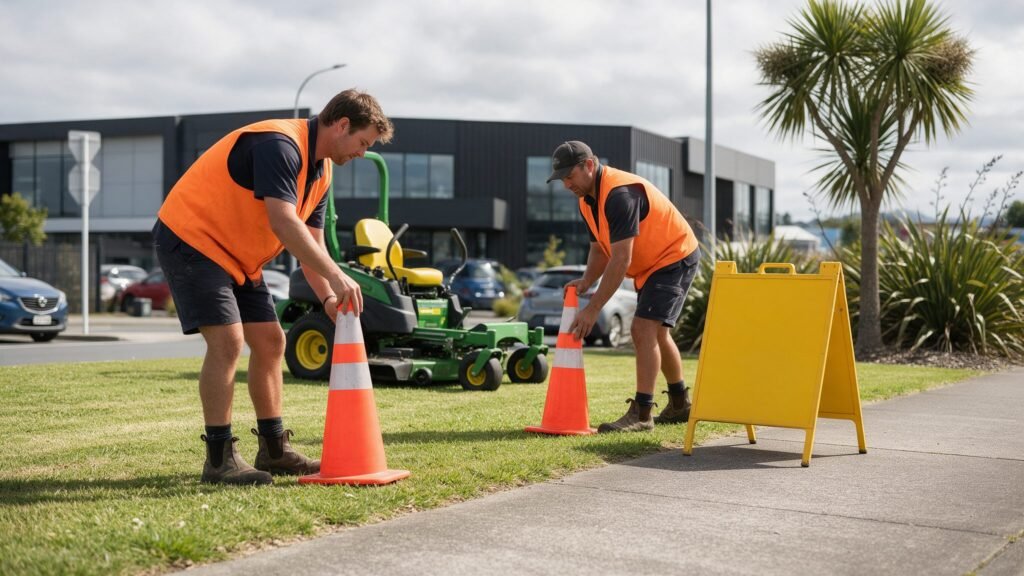
- Active exclusion zones: Erecting high-visibility cones, physical barriers or signage to keep pedestrians well clear of active machinery.
- Site sign-in and sign-out: Logging entry and exit times with property management or reception.
- Completion photo log: Capturing clear visual evidence of finished work, clear footpaths and closed security gates.
Your One Page Contractor Check Sheet
Save this 8-step verification process directly into your property management workflows:
- Verify Public Liability Cover: Confirm policy currency and active coverage limits.
- Request Safety Policy & Risk Register: Ensure machinery hazards are explicitly addressed.
- Check Spray Credentials: Verify Growsafe certification for any weed or pest control work.
- Exchange Emergency Contacts: Secure direct contacts for the site supervisor and operations lead.
- Conduct Site Walkthrough: Point out hidden hazards, sensitive boundary zones and high-foot-traffic paths.
- Agree on Exclusion Controls: Confirm how the crew will restrict access around working mowers and trimmers.
- Establish Incident Protocols: Reiterate that all near-misses or property damage must be reported within 2 hours.
- Schedule Annual Review: Log a re-verification date in your software system for all compliance documentation.
Frequently Asked Questions
- Am I responsible if a contractor is injured on my site?
You may have health and safety duties even when another business is doing the work. The contractor has duties relating to the work it controls. But overlapping duties can apply. Your responsibilities depend on the circumstances. WorkSafe recommends that PCBUs consult, cooperate and coordinate when their duties overlap.
- What is a PCBU in simple terms?
PCBU means a person conducting a business or undertaking. It can include a company, business or individual carrying out a business or undertaking. If you manage property as part of a business, your organisation may be a PCBU. PCBUs can have health and safety duties towards workers and other people affected by their work.
- Do I need to see my mowing contractor’s insurance certificate?
It is sensible to check that the contractor has current public liability insurance and to keep evidence on file. Insurance is also only one part of contractor management and does not replace health and safety controls.
- What is contractor prequalification and do I need it?
Prequalification is a process used to assess contractors against specified requirements before they are engaged. It can help with contractor selection. But it does not replace site-specific risk management. Whether you need a particular prequalification process depends on your organisation, procurement requirements and the nature of the work.
- Who is responsible for site hazards, the property manager or the contractor?
It depends on who has the ability to influence or control the risk. A contractor is responsible for the risks associated with the work it controls. The property manager or other PCBU may also have duties where it controls or influences the workplace or work. Overlapping duties must be managed together.
Make Contractor Management Easier
If you manage grounds across Tauranga, Mount Maunganui or Papamoa, you do not want a different health and safety conversation every time a contractor arrives.
You want a contractor who understands commercial sites, communicates clearly and can provide the information your team needs. Prowess Mowing works across property management portfolios, body corporate sites, schools and healthcare grounds.
Ask us for our health and safety pack and we will send it to you the same day. Contact our team and talk to us about your sites.
This article is general information and is not legal advice. Refer to WorkSafe New Zealand and your own adviser for your specific situation.